

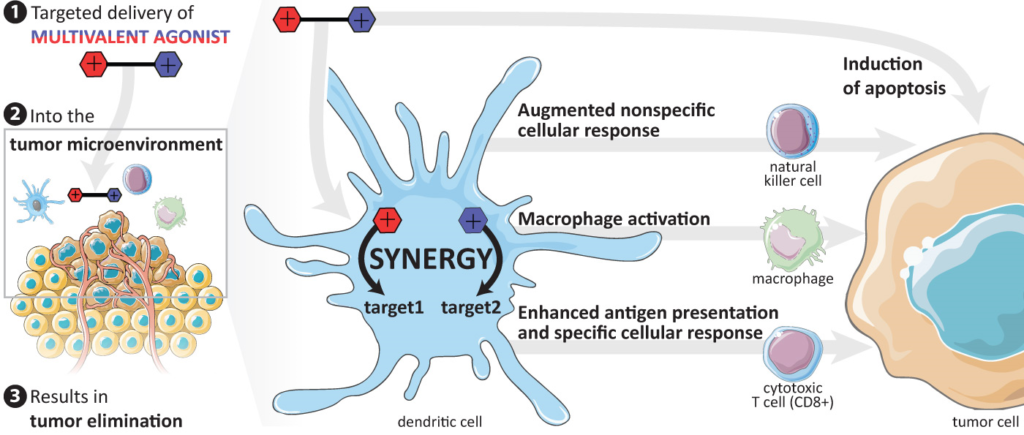
Our long-term goal is to improve vaccine performance using a chemical strategy of directing the immune system in terms of breadth, intensity, durability and the type of response to achieve an optimal response against an antigen of interest. We have been at the forefront of pattern recognition receptor (PRR) agonist discovery for the past decade and developed NOD-like receptor agonists endowed with potent immunostimulatory properties. Given that synergistic combinations of distinct PRR agonists can produce potent immune responses, we have also exploited the concept of using multiple agonists for robust activation of the immune system and addressed several possible PRR combinations. We have been constructing an ever expanding library of such conjugates with custom-tailored properties, which can be useful as adjuvants not only in prophylactic/therapeutic vaccines for infectious diseases but also in cancer vaccines. The synthesized conjugates might also possess the capacity to harness the synergies of innate immune system to eliminate tumors and provide long-term antitumor immunity.
Chemical Immunology Lab
Immunopharmacology
KEY PAPERS:
GUZELJ, Samo, WEISS, Matjaž, SLÜTTER, Bram, FRKANEC, Ruža, JAKOPIN, Žiga. Covalently conjugated NOD2/TLR7 agonists are potent and versatile immune potentiators. J Med Chem 2022, 65, 15085–15101, DOI: 10.1021/acs.jmedchem.2c00808.
GUZELJ, Samo, BIZJAK, Špela, JAKOPIN, Žiga. Discovery of desmuramylpeptide NOD2 agonists with single-digit nanomolar potency. ACS Med Chem Lett. 2022, 13, 1270-1277, DOI: 10.1021/acsmedchemlett.2c00121.
GUZELJ, Samo, NABERGOJ, Sanja, GOBEC, Martina, PAJK, Stane, KLANČIČ, Veronika, SLÜTTER, Bram, FRKANEC, Ruža, ŠTIMAC, Adela, ŠKET, Primož, PLAVEC, Janez, MLINARIČ-RAŠČAN, Irena, JAKOPIN, Žiga. Structural fine-tuning of desmuramylpeptide NOD2 agonists defines their in vivo adjuvant activity. J Med Chem. 2021, 64, 7809-7838, DOI: 10.1021/acs.jmedchem.1c00644.
GUZELJ, Samo, JAKOPIN, Žiga. Nucleotide-Binding oligomerization domain 1/Toll-like receptor 4 co-engagement promotes non-specific immune response against K562 cancer cells. Front Pharmacol. 2022, 13, 920928, DOI: 10.3389/fphar.2022.920928.