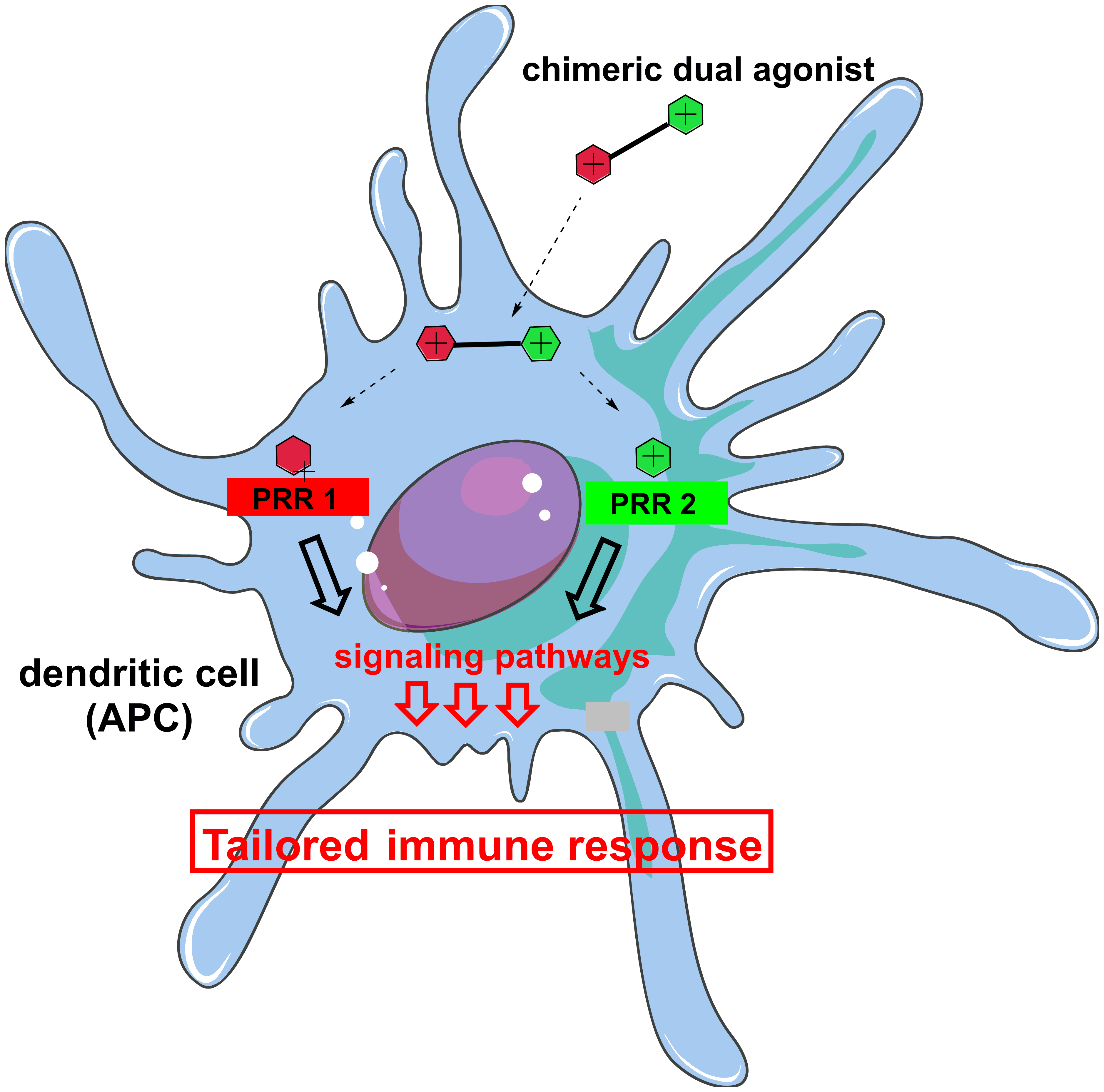

A critical research goal is to develop innovative new adjuvants capable of enhancing the immunogenicity of different vaccines. In the scope of this project, we designed and prepared novel NOD2 agonists and chimeric NOD2/TLR7 agonistic conjugates and their liposomal formulations with in vivo adjuvant activities. To obviate the major drawbacks of previously synthesized molecules, i.e. the in vivo metabolic instability and low permeation capacity, we focused on the development of more lipophilic and metabolically more stable NOD2 agonists incorporating ester bioisosteres and lipophilic moieties to improve permeation. In order to investigate possible favourable synergy between NOD2 and TLR7 agonists in terms of potency of adjuvant activity and the type of induced response, we designed chimeric NOD2/TLR7 agonistic conjugates by covalently linking our NOD2 agonists to known TLR7 agonists, affording innovative adjuvants.
Chemical Immunology Lab
Development of NOD2 agonists and dual NOD2/TLR7 agonistic conjugates as novel vaccine adjuvants (J3-9256) 2018-2022
Next-generation adjuvants for mucosal vaccines (J3-4496) 2022-2025
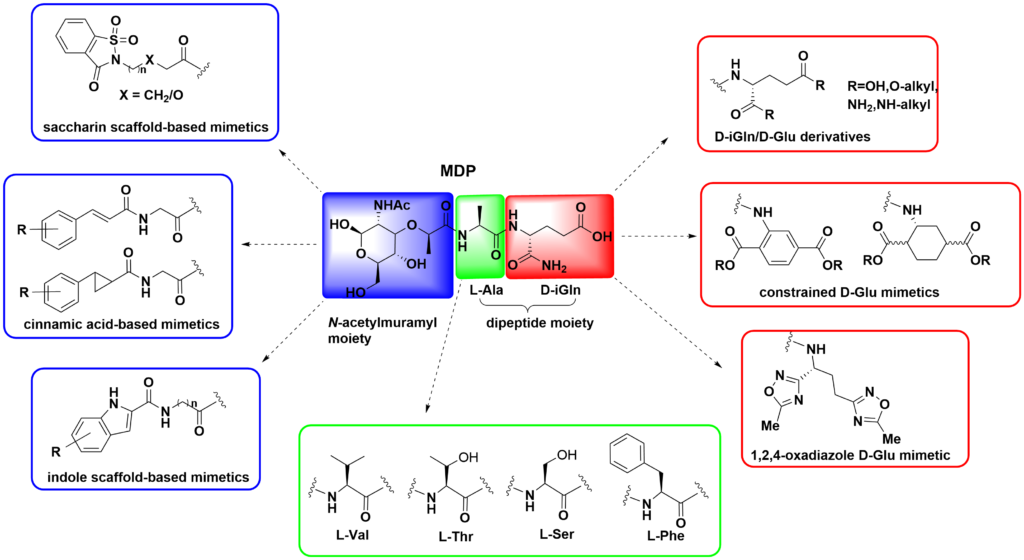
Our critical research goal is to develop innovative adjuvants capable of enhancing the immunogenicity of mucosal vaccines. To that end, we propose two approaches: (i) pharmacokinetic optimization of NOD2 agonists, which are known to induce mucosal immune responses; and (ii) advanced multi-targeted approach to adjuvant development, by imparting the synergies of innate immune system to a single molecule. To achieve this, we use an advanced chemical strategy to direct the immune system by constructing covalently linked multivalent conjugates, composed of NOD2 agonists and other innate immune ligands with unprecedented synergistic combinations. These conjugates will allow for simultaneous targeting of multiple targets within the same cell, thus enabling cross-activation of several arms of innate immune system. Since nanoparticles have successfully been used as carriers of antigens and adjuvants while also improving compound stability, our compounds will be formulated in these carriers. The ground-breaking results of this project will allow us to harness the full strength of immune system and pave the way for next-generation vaccines. Our innovative adjuvants will find medical applications as part of mucosal vaccines for treatment of infectious diseases caused by novel and existing mucosal pathogens thus improving public health, while our findings will also shed light on the underlying mechanisms of innate immunity.
Development of innate immune receptor-targeting chimeras as custom-tailored vaccine adjuvants (J3-2517) 2020-2023
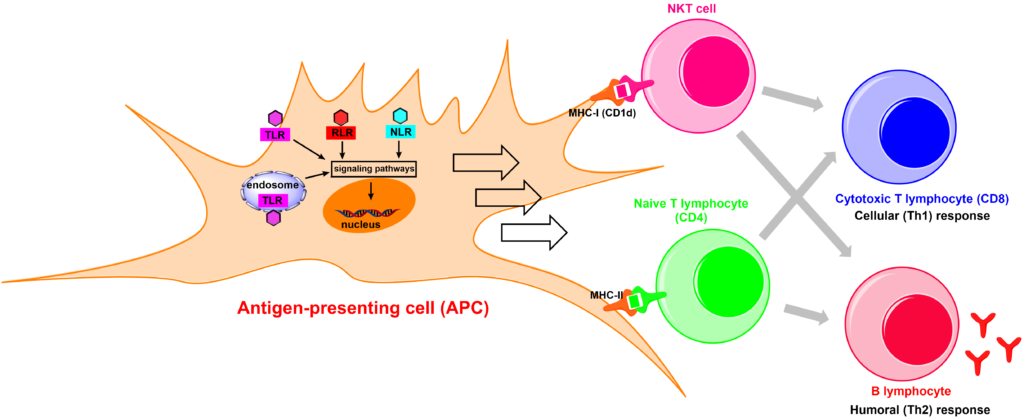
Our critical research goal is to develop innovative adjuvants capable of enhancing the immunogenicity of different vaccines. In the scope of this project, we proposed an advanced multi-targeted approach to adjuvant development, by imparting the synergies of innate immune system to a single molecule. To achieve this, we use an advanced chemical strategy to direct the immune system by constructing covalently linked multivalent agonists with unprecedented synergistic combinations. These conjugates allow for simultaneous targeting of multiple targets within the same cell, thus enabling cross-activation of several arms of the innate immune system. Since liposomes and nanoparticles have successfully been used as carriers of antigens and adjuvants and also promote a potent cellular response while improving compound stability against enzymatic stress, our conjugates will be formulated in these carriers. The ground-breaking results of this project will allow us to harness the full strength of immune system and pave the way for a next-generation vaccines. Beyond this, it can be foreseen that these highly innovative adjuvants will find medical applications as part of vaccines for treatment of infectious diseases thus improving public health, while our findings will also reveal fundamental new information about how immune cells operate and uncover the underlying mechanisms.