Chemical Strategies and Solutions for Bacteria and Cancer cell Resistance
New targeted cancer therapies
Despite significant advancements in cancer therapy, there remains a lack of efficient treatment options for certain types of cancer, including pancreatic cancer, triple negative breast cancer, and pediatric cancers like Ewing sarcoma. The current therapies for these cancers heavily rely on cytotoxic agents, which often come with undesirable side effects and limited effectiveness.
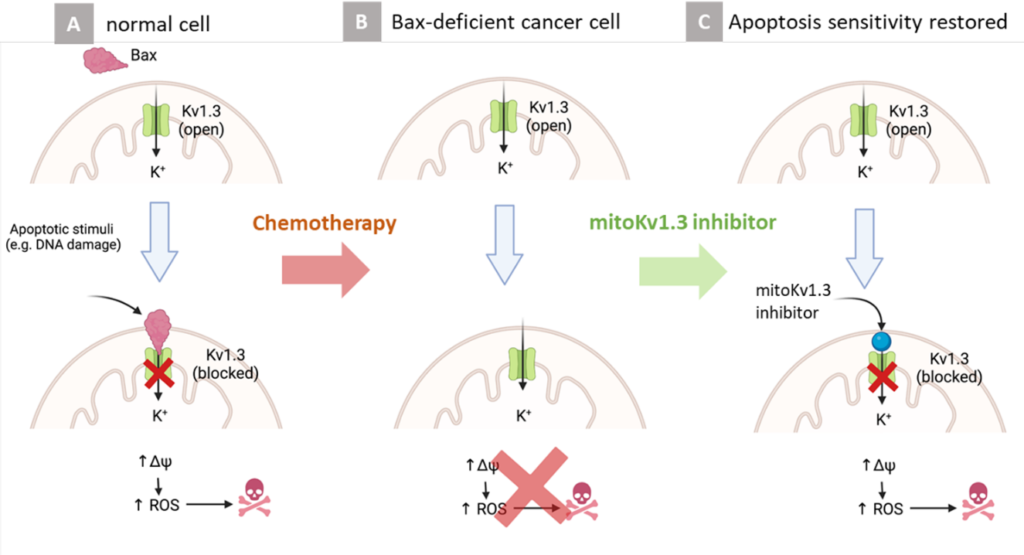
Our objective is to pioneer the development of novel targeted cancer therapies by focusing on relatively unexplored proteins, such as ion channels, topoisomerases and heat shock proteins. A specific approach we employ involves inhibiting mitochondrial proteins, specifically voltage-gated potassium channels and the mitochondrial Hsp90 isoform TRAP1. Through these innovative strategies, our goal is twofold: to develop targeted therapies for cancer types that lack effective treatment options and to induce apoptosis in cancer cells that have developed resistance to existing therapies.
THE RESEARCH IS SUPPORTED BY:
ARIS (Slovenian Research and Innovation Agency)
1. Targeting mitochondrial ion channels to induce apoptosis
Despite significant advancements in cancer therapy, there remains a lack of efficient treatment options for certain types of cancer, including pancreatic cancer, triple negative breast cancer, and pediatric cancers like Ewing sarcoma. The current therapies for these cancers heavily rely on cytotoxic agents, which often come with undesirable side effects and limited effectiveness.
Our objective is to pioneer the development of novel targeted cancer therapies by focusing on relatively unexplored proteins, such as ion channels, topoisomerases and heat shock proteins. A specific approach we employ involves inhibiting mitochondrial proteins, specifically voltage-gated potassium channels and the mitochondrial Hsp90 isoform TRAP1. Through these innovative strategies, our goal is twofold: to develop targeted therapies for cancer types that lack effective treatment options and to induce apoptosis in cancer cells that have developed resistance to existing therapies.
SCIENTIFIC GOALS:
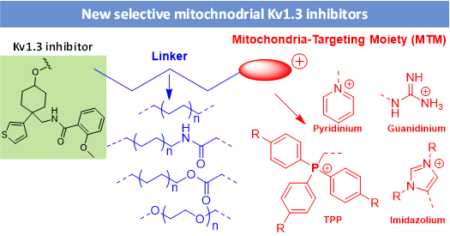
Development of a platform for the design and synthesis of mitochondrial targeting moieties (MTMs) with different physicochemical properties suitable for the synthesis of selective and potent mitochondrial ion channel inhibitors.
Develop novel optimized lead mitoKv1.3 inhibitors targeting specific properties of this channel, test in vitro pharmacodynamics, and design and test associations to target cancer from different angles.
To restore apoptosis in chemoresistant cancer cells by inhibiting mitoKv1.3 channels.
Develop improved tumor-specific mitoKv1.3 inhibitorsand nanodelivery system for mitoKv1.3 inhibitors either alone or in combination with anticancer drugs to increase intratumoral drug concentration.
KEY PAPERS:
GUBIČ, Š et al. Immunosuppressive effects of new thiophene-based KV3 inhibitors. European journal of Medicinal Chemistry 2023, art. 115561, https://www.sciencedirect.com/science/article/pii/S0223523423005275, DOI: 10.1016/j.ejmech.2023.115561.
GUBIČ, Š. et al. Design of new potent and selective thiophene-based Kv1.3 inhibitors and their potential for anticancer activity. Cancers. 2022, 14, 1-20. DOI: 3390/cancers14112595.
TOPLAK, Ž et al. 3D pharmacophore-based discovery of novel Kv10.1 inhibitors with antiproliferative activity. Cancers. 2021, 13, 1-24. https://www.mdpi.com/2072-6694/13/6/1244.
PETERLIN-MAŠIČ, Lucija, TOMAŠIČ, Tihomir, GUBIČ, Špela, PARDO A., Luis. Mitochondriotropic benzamide potassium channel Kv1.3 inhibitors: LU patent application LU501901, 22. April 2022. Luxembourg: LU Luxembourg Intellectual Property Office, 2022.
2. HSP90 inhibitors
Proper protein folding under stress conditions in cancer cells is mediated by chaperones like heat shock protein 90 (Hsp90). The role of Hsp90 chaperone in cancer is unique, as its client proteins, such as transcription factors, protein kinases and nuclear receptors, are involved in all ten hallmarks that lead to a neoplastic state. Hsp90 has more than 400 client proteins that act in cell cycle and signalling processes and are therefore critical factors in cancer progression, initiation, and/or metastasis.
SCIENTIFIC GOALS:
Develop new Hsp90 C-terminal domain inhibitors with favourable physicochemical properties and potent anticancer activity in breast cancer and pediatric sarcoma models, which do not induce a heat shock response.
Develop new structural classes of Hsp90 isoform-selective N-terminal domain inhibitors with potent anticancer activity.
Identify novel drug combinations of these Hsp90 inhibitors with other anticancer drugs to achieve synergistic activity.
Design new Hsp90-mediated targeting chimeras (HEMTACs) for efficient oncogene degradation, especially in pediatric sarcomas.
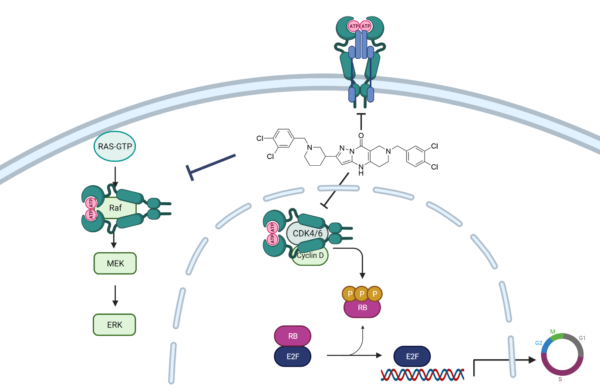
Figure. Hsp90 C-terminal domain inhibitor induces degradation of several ongogenic proteins in Ewing sarcoma cells.
KEY PAPERS:
DERNOVŠEK, J. et al. Exploration and optimisation of structure-activity relationships of new triazole-based C-terminal Hsp90 inhibitors towards in vivo anticancer potency. Biomedicine & Pharmacotherapy. 2024, 177, 16941, DOI: 10.1016/j.biopha.2024.116941.
DERNOVŠEK, J. et al. First dual inhibitors of human topoisomerase IIα and Hsp90 C-terminal domain inhibit the growth of Ewing sarcoma in vitro and in vivo. Bioorganic Chemistry. 2024, 153, 107850, DOI: 10.1016/j.bioorg.2024.107850.
DERNOVŠEK, J. et al. Hiding in plain sight : optimizing topoisomerase IIα inhibitors into Hsp90β selective binders. European Journal of Medicinal Chemistry. 2024, 280, 116934, DOI: 10.1016/j.ejmech.2024.116934.
ZAJEC, Ž. et al. New class of Hsp90 C-terminal domain inhibitors with anti-tumor properties against triple-negative breast cancer. Journal of Medicinal Chemistry. 2024, 67, 12984-13018, DOI: 10.1021/acs.jmedchem.4c00932.
DERNOVŠEK, J. et al. Discovery of new Hsp90–Cdc37 protein–protein interaction inhibitors : in silico screening and optimization of anticancer activity. RSC Advances. 2024, 14, 28347–28375, DOI: 10.1039/D4RA05878J.
3. Inhibitors of voltage-gated proton channel Hv1
Voltage-gated proton channels (Hv1) are proton-selective, voltage-dependent channels found in various cell types such as macrophages, B lymphocytes, microglia and sperm cells. They are responsible for maintaining intra- and extracellular pH at physiological levels, which is essential for many biological functions such as proliferation, mobility and apoptosis. Overexpression of Hv1 has been shown to promote tumour formation by highly metastatic cancer cells and is associated with neuroinflammatory diseases, immune response disorders and infertility, suggesting a potential use of hHv1 inhibitors in numerous therapeutic areas.
SCIENTIFIC GOALS:
Development of new inhibitors for Hv1 channels by structure-based design.
Evaluation of the activity of inhibitors for Hv1 channels and their selectivity for other voltage-gated ion channels using electrophysiological methods.
Optimization of inhibitors to obtain molecules with improved inhibitory potency, better hHv1 channel selectivity and desired physicochemical properties.
Investigation of the effects of inhibitors on tumour cell function and tumour growth.
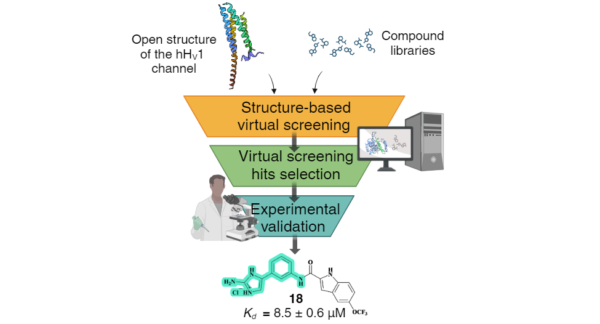
Figure. Strategy for the discovery of novel human Hv1 channel inhibitors.
.
KEY PAPERS:
PIGA, M. et al. Identification of a novel structural class of Hv1 inhibitors by structure-based virtual screening. Journal of Chemical Information and Modeling. 2024, 64, 4850-4862, DOI: 10.1021/acs.jcim.4c00240.
This website uses cookies to improve your experience. If you continue to use this site, you agree with it.